
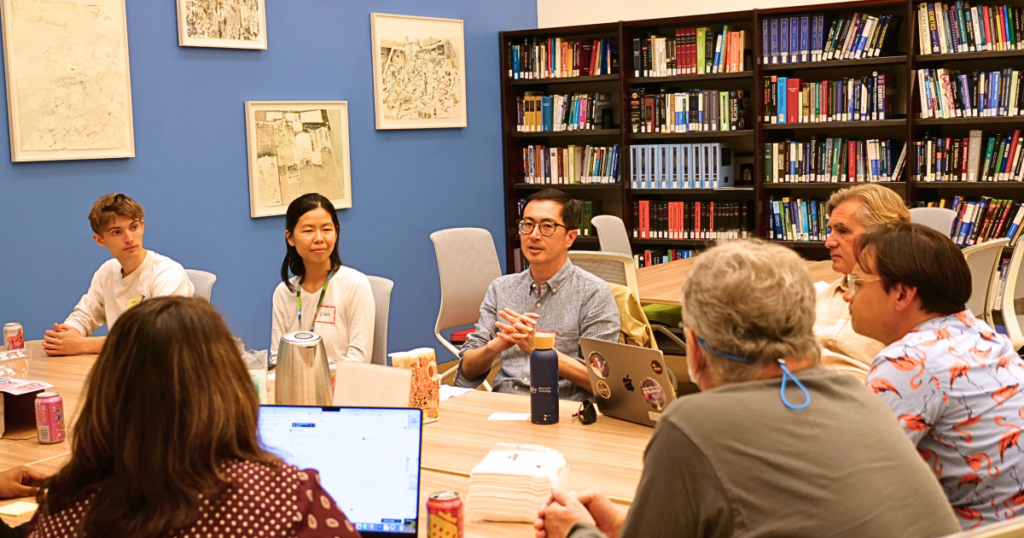

With artificial intelligence (AI) becoming more embedded in our daily lives, the Data Science and Open Scholarship team saw an opportunity to host conversations for UCSF community members thinking about the impacts of the evolving technology. Over three sessions this summer, participants gathered at the FAMRI Library in Mission Bay to discuss AI in relation to humanity and the future. The discussion topics were:
- Should AI mimic humans (or should machines stay machines)?
- Keeping the human in the loop
- Are we headed for AI dystopia?
These topics were intentionally provocative, and the articles selected for pre-reading represented a variety of perspectives.
Each standalone session had eight to 14 participants, representing various disciplines. We were joined by students, librarians, AI specialists, administrative staff, retirees, and even software engineers. Naturally, attitudes towards AI varied across participants, but the conversations that emerged were thought-provoking and nuanced. In preparation for each session, two or three articles were selected to inspire conversation.
The sessions
In the first session, we reflected on whether AI tools can and should be trained for empathy, and what this empathy would look like. A lack of sensitivity to human emotions seemed dangerous to the group, yet too much of it felt uncanny and invasive. We also reflected on the extent to which we individually tend to humanize AI. For example, do we say “please” in front of each prompt, or do we treat it as a colleague more than a tool? We also discussed what does this behavior say about humans, and about the AI companies that brand their products with human-like names and skill sets.
Session two built on some of the previous questions by examining the role of humans in AI workflows. Conversations focused on balancing workload delegation and critical thinking, efficiency and human agency. We considered technological changes across time, noting how intuitive design and minimalism have come to define user interfaces, and asked ourselves whether there have been times when we preferred an older model or version of technology over something newer.
Finally, in the third session, we weighed the potentials and risks of AI, and how it should be governed, in the form of several questions. Is open source the future? Against ever-shifting red lines in our personal and professional lives, can regulations ever be meaningful? What do we hope that institutions and governments will do, and do we personally have principles for AI use? When it comes to AI shaping the future, why is it that doomsday scenarios often come to mind before best case scenarios, such as AI curing cancer?
As the discussion club moves into its next phase, we may have more questions than answers. But innovative thinking starts with good questions, and sometimes, knowing that other people share your questions is itself a source of comfort in face of a constantly evolving landscape.
Next phase of the AI Discussion Club
The AI Discussion Club returns this fall and online as part of the AI in Your Toolkit series. You can register for the next session, Are we in an AI bubble? Vapid vs. meaningful AI integration on Wednesday, November 4, 2-3 p.m. via Zoom.
If you have ideas or suggestions for the AI Discussion Club, please contact the Data Science and Open Scholarship team.